Avoiding Cheap eBike Online Scams: A 2026 Guide
Table of Contents
- Why Cheap eBike Scams Are Becoming More Common
- How to Spot a Fake E-Bike Website
- Safe Payment Methods for Buying an eBike Online
- Buying a Second-Hand eBike Online Safely
- What to Do After an Online Shopping Scam
- Key Steps to Avoid Cheap eBike Scams
- Why Local Expertise Matters When Buying Online
- Frequently Asked Questions
Last Updated: October 19, 2026
Why Cheap eBike Scams Are Becoming More Common
Online fraud targeting eBike buyers has grown significantly because the market itself is expanding rapidly. More people are searching for affordable options, and scammers exploit that demand by creating convincing fake websites and listings. The combination of high product value, international shipping complexity, and buyer inexperience creates perfect conditions for theft.
Scammers know that eBike purchases represent substantial investments. A legitimate model might cost several hundred pounds, making it worth the effort for criminals to set up elaborate fake storefronts. They often copy designs from real retailers, use stolen images, and operate for just long enough to collect payments before disappearing.
Understanding how these scams work helps you protect yourself.
The good news: you can avoid these scams by learning to spot red flags. Most fake sites share common characteristics. Once you know what to look for, you'll move through the buying process with confidence.
How to Spot a Fake E-Bike Website
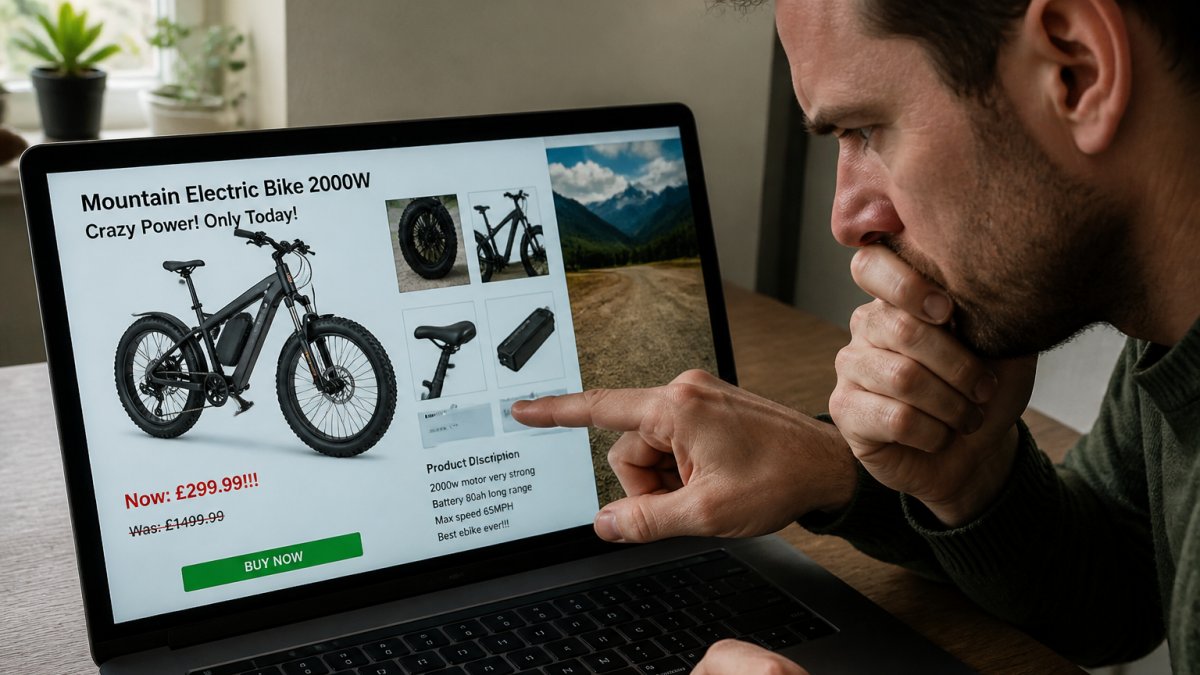
The best defence against cheap ebike online scams starts with recognising a fraudulent website before you enter payment details. Fake sites often look professional at first glance, but they contain telltale mistakes that reveal their true nature.
Legitimate retailers invest in their online presence. They use professional photography, clear product descriptions, and consistent branding. Fake sites cut corners. They rush through design, reuse images from other sites, and sometimes copy entire pages without updating details.
Red Flags in Website Design and Content
Poor grammar and spelling errors appear throughout fake sites. Look for awkward phrasing, inconsistent capitalisations, and sentences that don't quite make sense. Real businesses hire people to review their copy.
Product images tell a story. Scammers steal photos from legitimate retailers or use generic stock images. If you see the same eBike photo on multiple websites with different brand names, that's a major warning sign. Use reverse image search tools to check where photos originated.
Pricing that seems too good is the most obvious red flag. An eBike listed for £39.99 doesn't exist. Neither does one for £199 when identical models elsewhere cost £800. Scammers use absurdly low prices to generate clicks and inquiries.
Check these specific elements:
- Website domain: Does it match the company name? Fake sites use domains like "ebike-deals-uk.com" when claiming to be "Premium eBikes Ltd."
- HTTPS security: Look for the padlock icon in your browser. Legitimate sites use SSL certificates. Fake sites sometimes skip this step.
- Contact information: Real businesses list phone numbers, email addresses, and physical locations. Try calling the number. If it doesn't work or rings to a confused person, that's a red flag.
- Return policy: Legitimate retailers clearly state how returns work. Fake sites often have vague or missing return policies.
- Social media presence: Check their Facebook, Instagram, or Twitter. Fake businesses either have no social accounts or accounts created very recently with few followers.
Checking Company Registration and Contact Details
Every legitimate business in the UK should be registered with Companies House. You can search for free at Companies House. Enter the business name or registration number.
Look for a physical address on the website. Scammers sometimes use real addresses of other businesses or post office boxes. Search the address on Google Maps. Does it match the business type?
Phone numbers should be real and answered by actual people. Call during business hours. Ask specific questions about their products and shipping. Real businesses can answer immediately. Scammers often avoid phone contact entirely.
Email addresses matter too. Legitimate companies use professional domains (info@companybikes.co.uk). Scammers use free email accounts (companybikes@gmail.com) or generic addresses.
Safe Payment Methods for Buying an eBike Online
Choosing the right payment method is your primary protection when trying to avoid cheap ebike online scams. Different methods offer different levels of buyer protection.
Credit cards provide strong protection through chargeback processes.
Debit cards offer less protection than credit cards. Banks can sometimes reverse fraudulent transactions, but the process takes longer and isn't guaranteed.
PayPal offers buyer protection for eligible purchases. If you don't receive your item or it arrives significantly different from the description, PayPal can refund your money.
Bank transfers and wire transfers provide almost no protection. Once the money leaves your account, it's gone. Scammers love these methods because they're irreversible.
Payment Protection and Buyer Guarantees
Always use payment methods that offer buyer protection. This is non-negotiable for expensive items. The few extra seconds it takes to use a protected method could save you hundreds of pounds.
Check whether the retailer offers a money-back guarantee. Legitimate businesses often guarantee satisfaction or offer returns within 14-30 days. If they refuse to offer any guarantee, that's suspicious.
Some retailers use third-party payment processors that hold money in escrow. The processor releases payment to the seller only after you confirm receipt of the item. This arrangement protects both buyer and seller.
Buying a Second-Hand eBike Online Safely
Second-hand eBike purchases carry different risks than new ones. The seller might misrepresent the bike's condition, hide battery problems, or disappear after receiving payment.
Platforms like Facebook Marketplace and eBay offer some buyer protection, but less than you'd get from established retailers. Private sellers often can't be held accountable if something goes wrong.
Verifying Condition and Battery Health
Ask for detailed photos showing the entire bike from multiple angles. Request close-ups of the battery, motor, and frame. Look for cracks, corrosion, or signs of damage. A seller willing to provide extensive photos is usually legitimate.
The battery is the most expensive component to replace. Ask how many charge cycles it has completed. A battery showing 80% of original capacity after 500 cycles is normal. One showing 50% capacity after 100 cycles suggests a defect.
Request the original purchase receipt or proof of warranty if available. This helps verify the bike's age and authenticity.
Meeting Sellers and Inspecting Before Payment
Always meet in a public location during daylight. Never go alone. Bring someone with you who can observe the transaction.
Test ride the eBike before handing over money. Check the motor responsiveness, brake function, and battery indicator. The display should show accurate charge levels.
Bring a basic multimeter if you have one. You can check battery voltage to verify it matches the stated specification. Most sellers won't mind this verification process.
Never pay before inspecting the bike in person. Even if the seller pressures you, wait until you've seen it. Legitimate sellers understand this caution.
What to Do After an Online Shopping Scam
If you've been scammed, act quickly. The sooner you report it, the better your chances of recovery.
Reporting and Recovery Steps
Contact your payment provider immediately. If you used a credit card or PayPal, report the fraudulent transaction within 48 hours if possible. Provide clear documentation of what happened.
Report the scam to Action Fraud, the UK's national fraud reporting service. You can report online at Action Fraud.
If you paid through a marketplace like eBay or Facebook, report the seller through that platform's resolution centre.
Keep detailed records of everything:
- Screenshots of the website and product listing
- Confirmation emails or payment receipts
- Messages between you and the seller
- Bank or credit card statements showing the transaction
Contact your bank's fraud department. They can sometimes recover money even after it's left your account, particularly if the recipient bank hasn't processed the transfer yet.
Report the fake website to the National Cyber Security Centre. Many legitimate retailers also want to know if scammers are impersonating them.
Key Steps to Avoid Cheap eBike Scams
The most effective approach to avoiding cheap ebike online scams combines multiple verification steps. Don't rely on just one check.
Before making any purchase:
- Verify the company exists through Companies House
- Call their phone number and speak to a real person
- Check for recent social media activity and customer reviews
- Use reverse image search on product photos
- Look for professional website design and correct spelling
- Compare pricing against established retailers
- Use credit card or PayPal payment methods
- Read their return and warranty policies carefully
For second-hand purchases specifically:
- Meet in public locations during daylight
- Bring someone with you
- Test the eBike before paying
- Request detailed photos and battery information
- Never pay before inspecting the item
These steps take 15-20 minutes but could save you hundreds of pounds.
Why Local Expertise Matters When Buying Online
Buying online offers convenience, but it removes one important advantage: expert guidance. You can't ask questions about fit, performance, or maintenance from a computer screen.
This is where local retailers matter. County eBikes, based in Andover, provides free test rides by appointment.
When you buy from an unknown online retailer, you're taking a risk.
Many customers ask whether online prices justify the convenience.
Avoiding cheap ebike online scams requires vigilance, but it's absolutely achievable. Start by checking company registration, verifying contact information, and using protected payment methods.
County eBikes has spent years helping customers find the right eBike and supporting them long-term.
| Red Flag Type | What to Look For | Action to Take |
|---|---|---|
| Website Design | Poor spelling, stolen images, mismatched branding | Search the domain or image on Google |
| Pricing | Unrealistically low prices (under £200) | Compare against established retailers |
| Contact Details | Missing phone number, free email address only | Call and speak to a real person |
| Company Registration | No Companies House listing | Search at companieshouse.gov.uk |
| Payment Method | Request for bank transfer or wire only | Use credit card or PayPal instead |
| Second-Hand | Seller refuses to meet or test ride | Walk away and find another seller |
Frequently Asked Questions
How can I tell if an online e-bike shop is legitimate?
Check for a physical address, phone number, and email contact details on the website. Verify the company is registered with Companies House using their company number. Look for genuine customer reviews on independent sites, not just testimonials on their own website. Legitimate sellers display clear returns policies, payment security badges, and contact information. Be wary of sites with poor grammar, stock photos that look generic, or prices far below market rates. When avoiding cheap ebike scams, always research the business before making a purchase.
What payment methods offer the best protection when buying an eBike online?
Credit cards provide strong protection, meaning your card issuer shares liability if something goes wrong. PayPal Buyer Protection covers eligible purchases if the item doesn't arrive or differs from the description. Debit card purchases offer less protection, though your bank may help if you report fraud quickly. Avoid bank transfers or cryptocurrency, which offer no recourse if the seller disappears. Safe payment methods for buying an e-bike online should always include a dispute resolution option.
What should I check before buying a second-hand eBike online?
Request photos and videos of the bike from multiple angles, including close-ups of the battery, motor, and frame for cracks or damage. Ask about battery health, how many charge cycles it has had, and whether the seller has service records. Verify the frame number matches any documentation. Arrange a local inspection if possible, or ask for a video call walkthrough. Check the seller's feedback history on the platform they're using. Buying a second-hand e-bike online safely means confirming the bike's age, usage, and whether warranty or guarantee remains valid.
What should I do if I've been scammed when buying an e-bike online?
Contact your payment provider immediately to report the fraud and request a chargeback or reversal. Gather evidence: screenshots of the listing, emails, and payment confirmation. Report the scam to Action Fraud (the national fraud reporting service) at actionfraud.police.uk. If you used a marketplace like eBay or Facebook Marketplace, report the seller and listing. Document everything and keep records for your bank or payment provider. What to do after an online shopping scam includes checking whether you're eligible for compensation.