Commuting 30 Miles by eBike: A Practical UK Guide
Table of Contents
- Is a 30 Mile eBike Commute Realistic Every Day?
- How Long Does It Take to Cycle 30 Miles on an eBike?
- What to Look For in an eBike for a 30 Mile Commute
- Charging an eBike at Work: Practical Options
- eBike Commuting Tips for Long Distances
- Looking After Your eBike When You Ride It Daily
- Frequently Asked Questions
Last Updated: 12 October 2026
Is a 30 Mile eBike Commute Realistic Every Day?
Commuting 30 miles by ebike is realistic for many riders, but it depends on the bike, the route and how you manage the battery. A 30-mile round trip sits within reach of most quality e-bikes, yet a daily 30-mile each-way commute asks far more of both rider and machine.
At County eBikes in Andover, we fit riders for exactly this kind of riding every week. The honest answer is that range claims on paper rarely match real-world results. Hills, headwinds, rider weight and how much you pedal all change the maths.
So the question is not "can an e-bike do 30 miles?" Most can. The real question is whether it can do it every day, in all weather, without leaving you stranded or worn out.
What e-bike commuting range actually means in practice
Range figures assume ideal conditions. In practice, you should plan for less.
A battery rated for a certain distance will deliver roughly 60-70% of that on a hilly route with a loaded rider. Cold weather cuts it further.
- Flat, mild, light rider: close to the stated range
- Hilly, cold, heavy load: noticeably less
- Full power assist: the biggest drain of all
- Low assist, steady pedalling: the most efficient
The fix is simple: always keep a buffer. If your round trip is 30 miles, buy a bike that claims 45 or more.
Energy Saving Trust guidance on electric bikes notes that e-bikes suit commutes where a car feels wasteful but the distance is too far to pedal unassisted.
How Long Does It Take to Cycle 30 Miles on an eBike?
Cycling 30 miles on an e-bike typically takes 1.5 to 2.5 hours, depending on assist level, terrain and traffic. That works out at roughly 12 to 20 mph on average.
The e-bike does not make you a cyclist who never sweats. It makes the same journey faster and less exhausting.
On a legal UK e-bike, motor assistance stops at 15.5 mph (Riding an electric bike: the rules). Above that, you are pedalling under your own power. So a 30-mile ride is a real ride, not a free pass.
- Fast commuter pace: about 1.5 hours
- Relaxed pace with stops: closer to 2.5 hours
- Urban route with lights and junctions: add 20-30 minutes
For a 30-mile each-way commute, that is a serious daily time commitment. For a 15-mile each-way trip, it is very manageable.
What to Look For in an eBike for a 30 Mile Commute
The best e-bike for a 30 mile commute balances battery size, motor type and low maintenance. For most riders, a lightweight bike with a torque sensor and a belt drive is the sweet spot.

Weight matters more than most buyers expect. A lighter bike is easier to lift, store and pedal when the battery runs low.
Look for these essentials:
- Battery: 360Wh or more for a 30-mile round trip
- Motor: 250W, as UK law requires for road use
- Sensor: torque sensing for natural, responsive power
- Brakes: hydraulic disc brakes for reliable stopping
- Tyres: puncture-resistant for fewer roadside repairs
Our CGO600 Pro lightweight belt drive electric bike is a good example. It pairs a 360Wh battery with LG cells, a 250W rear hub motor and a Gates carbon belt drive. At 16kg, it is light enough to carry up stairs.
GOV.UK rules on electric bike use confirms that e-bikes must meet power and speed limits to stay road legal without a licence.
Motor type: hub versus mid-drive
Hub motors sit in the rear wheel. They are simple, quiet and low maintenance. They suit flat to rolling commutes.
Mid-drive motors sit at the pedals. They use the bike's gears, so they climb steep hills better and feel more natural. They cost more and need more care.
For a mostly flat 30-mile commute, a hub motor is the practical pick. For a hilly route, a mid-drive earns its keep.
CGO600 Pro lightweight belt drive electric bike →
Drive system: belt versus chain
A belt drive uses a carbon belt instead of a metal chain. It needs no oil, runs quietly and lasts far longer.
A chain is cheaper to replace and offers more gears. But it needs regular cleaning and oiling, especially in wet UK weather.
If you ride daily, a belt drive saves you real maintenance time. That is why we lean towards belt-drive models for committed commuters.
Charging an eBike at Work: Practical Options
Charging an e-bike at work is straightforward if you plan ahead. Most e-bike batteries are removable, so you can carry the battery inside and charge it at your desk.
Check these things before you rely on workplace charging:
- Ask first: get permission from your employer or building manager
- Know the battery weight: most are 2-3kg and easy to carry
- Charge to 80%: this extends battery life over years of use
- Use the right charger: always use the one supplied with your bike
- Store safely: keep batteries away from extreme heat
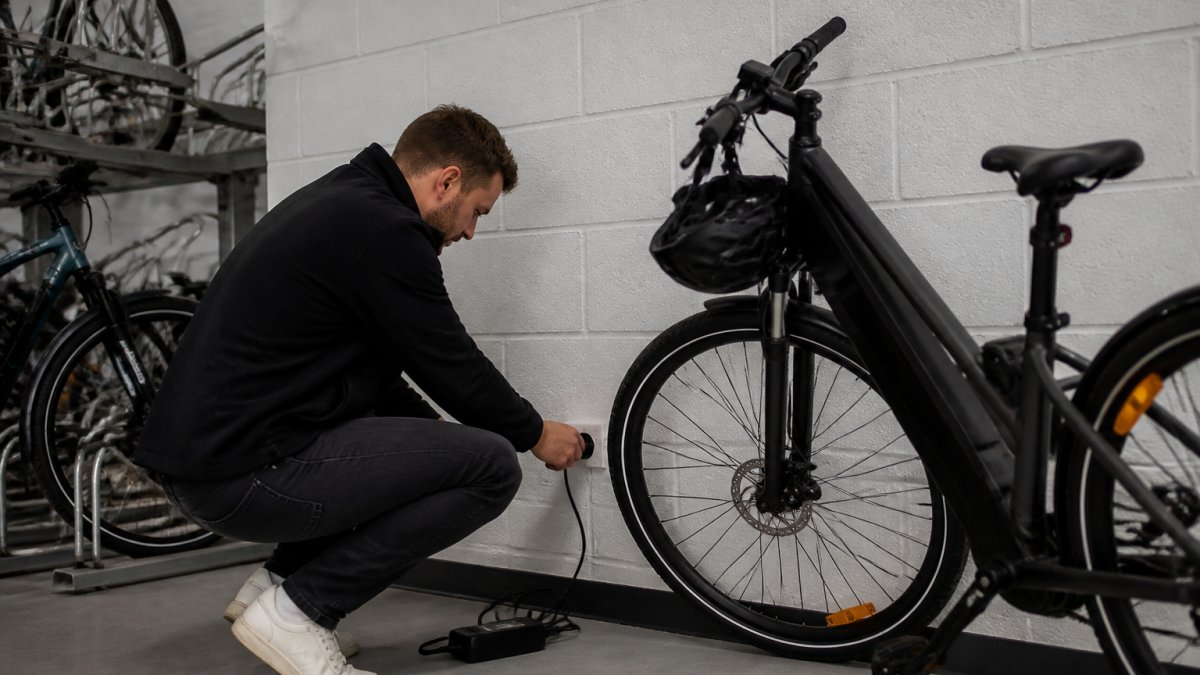
If your workplace has no charging, a second charger kept at your desk solves the problem. A full charge from empty usually takes 3 to 5 hours.
eBike Commuting Tips for Long Distances
Good e-bike commuting tips for long distances come down to planning, comfort and pacing. Small choices before you ride make the biggest difference.
Route planning matters more than any gadget. A quiet, flatter route beats a short, busy one every time.
- Plan your route: use cycle paths and quiet roads where you can
- Test the ride first: try it on a day off before you commit
- Carry a repair kit: spare tube, pump and multi-tool
- Dress for the weather: layers and waterproofs, not one thick coat
- Charge at both ends: top up at work to halve your daily range need
Route planning and kit
Pick a route with fewer hills and less traffic. Even a longer path can be faster and safer.
Your kit should cover the basics: lights, a lock, a repair kit and waterproof clothing. Keep a charger at work if you can.
We offer free local test rides by appointment, so you can try a full commute route before you buy.
Looking After Your eBike When You Ride It Daily
Daily riding wears parts faster, so a simple maintenance routine pays off. Clean, check and top up your bike on a schedule.
- Weekly: check tyre pressure and brake feel
- Monthly: clean the drivetrain and check bolts
- Every few months: inspect brake pads and tyres for wear
- Battery care: store it cool and avoid full drains
A hub-motor bike with a belt drive needs less fuss than a chain-driven model. But every e-bike benefits from regular checks.
Our fully equipped Andover workshop services all makes and models. If you are searching for e-bike servicing near me in Andover, we can keep your daily ride running smoothly year after year.
| Task | How Often | Why It Matters |
|---|---|---|
| Tyre pressure check | Weekly | Prevents punctures and drag |
| Drivetrain clean | Monthly | Keeps gears smooth |
| Brake pad check | Every 3 months | Protects your safety |
| Battery top-up | Daily | Avoids deep discharge |
Frequently Asked Questions
Is a 30 mile e-bike commute practical every day?
Yes, if the bike and battery suit the distance. A 30 mile e-bike commute works best with a battery and motor that handle hills without draining quickly, and a charging routine at both ends. Riders who treat it as a training ride rather than a race arrive fresh. The main practical limit is time, not the bike itself.
How long does it take to cycle 30 miles on an e-bike?
Most commuters average 15 to 18 mph on an e-bike, so a 30 mile ride takes roughly 1 hour 45 minutes to 2 hours. Traffic lights, hills and slower shared paths add time. Riding at the motor's assistance limit rather than above it keeps the pace steady and saves battery for the return leg.
Can an e-bike battery last for a 30 mile commute?
A 360Wh battery with LG cells, like those on the Tenways CGO600 Pro, will cover around 25 to 35 miles in mixed conditions, so a 30 mile commute is achievable but tight. A 560Wh battery such as the one on the AGO Air gives a stated 60 mile range, which leaves a comfortable margin for headwinds and cold weather.
Can I charge my e-bike battery at work?
Many workplaces allow it, but ask first and follow the battery manufacturer's guidance. Charge in a cool, dry, well-ventilated space away from fire exits, never leave a charging battery unattended overnight, and use the charger supplied with the bike. A second charger kept at work saves carrying one back and forth.
A daily 30-mile commute is a real test of any e-bike, and the wrong bike will let you down within a year. County eBikes handpicks premium models built for exactly this kind of use, backed by our fully equipped workshop and a 4.8 rating from 253 reviews. With free local test rides, 0% finance and free UK mainland delivery on orders over £60, getting the right bike is simpler than you think. Get started with County eBikes and ride your commute with confidence.