eBike Motor Diagnostic Tools Explained: A 2026 Guide
Table of Contents
- Why eBike Motor Diagnostics Matter Before You Replace Anything
- eBike Motor Fault Symptoms: What Your Bike Is Telling You
- The Main Types of eBike Diagnostic Tool Explained
- e-Bike Motor Testing With a Multimeter: A Step-by-Step Method
- e-Bike Hub Motor Hall Sensor Test: Checking the Three Wires
- What to Ignore: Common Bad Advice About eBike Motor Diagnostics
- When to Hand Your eBike to a Specialist Workshop
- Conclusion
- Frequently Asked Questions
Last Updated: 14 October 2026
Why eBike Motor Diagnostics Matter Before You Replace Anything
With ebike motor diagnostic tools explained, a motor that cuts out on a climb is rarely dead. Most eBike motor faults trace back to a handful of fixable causes, and testing before you replace saves both money and a perfectly good motor. That principle sits at the heart of how we approach repairs at County eBikes in Andover: diagnose first, replace last.
eBike motor diagnostic tools explained simply means the instruments and software used to test whether a motor, controller, sensor or wiring loom is actually faulty. Get that wrong and you buy a new motor you never needed.
This guide covers the symptoms worth acting on, the main tool types, and how to run an e-bike motor testing with a multimeter check yourself.
eBike Motor Fault Symptoms: What Your Bike Is Telling You
Most motor problems announce themselves well before total failure. The trick is knowing which symptom points to which component.
Common e-bike motor fault symptoms include:
- Intermittent power cut-outs under load, often a hall sensor or loose connector
- Grinding or clicking from the hub, usually bearing wear or internal damage
- Motor runs but delivers no assistance, typically a controller or phase wire fault
- Error codes on the display, which narrow the fault to a specific circuit
- Reduced range with no motor noise, which usually points to the battery rather than the motor
A common mistake is assuming any power loss means a dead motor. In practice, connectors, sensors and controllers fail far more often than motor windings.
The Main Types of eBike Diagnostic Tool Explained
An e-bike diagnostic tool falls into two broad families: general electrical instruments and brand-specific software. Most home mechanics need the first; dealers need both.
Handheld Multimeters
A multimeter measures voltage, continuity and resistance. It is the single most useful tool for tracing where power stops flowing, and it costs very little compared with replacing parts on guesswork. This is the tool we reach for first in our Andover workshop on almost every motor fault.
Brand-Specific Diagnostic Software
Many motor systems (Bosch, Shimano, Yamaha and similar) have dealer software that reads fault codes directly from the controller. It is fast and precise, but it is usually locked to authorised dealers. If your motor is a sealed, brand-specific unit, this software often answers in minutes what a multimeter takes an hour to find.
| Tool | What it tests | Best for | Access |
|---|---|---|---|
| Multimeter | Voltage, continuity, resistance | Wiring, sensors, phase wires | Anyone |
| Brand diagnostic software | Fault codes, motor data | Sealed brand systems | Dealers |
| Battery load tester | Voltage under load | Range and cut-out faults | Workshops |
e-Bike Motor Testing With a Multimeter: A Step-by-Step Method
Testing a motor with a multimeter takes about 20 minutes and needs no specialist kit. Work methodically and you will isolate most faults.
Total Time: 20-30 minutes Difficulty: Beginner to intermediate
What You'll Need
- Digital multimeter
- Basic screwdriver set
- The motor's wiring diagram if you have it
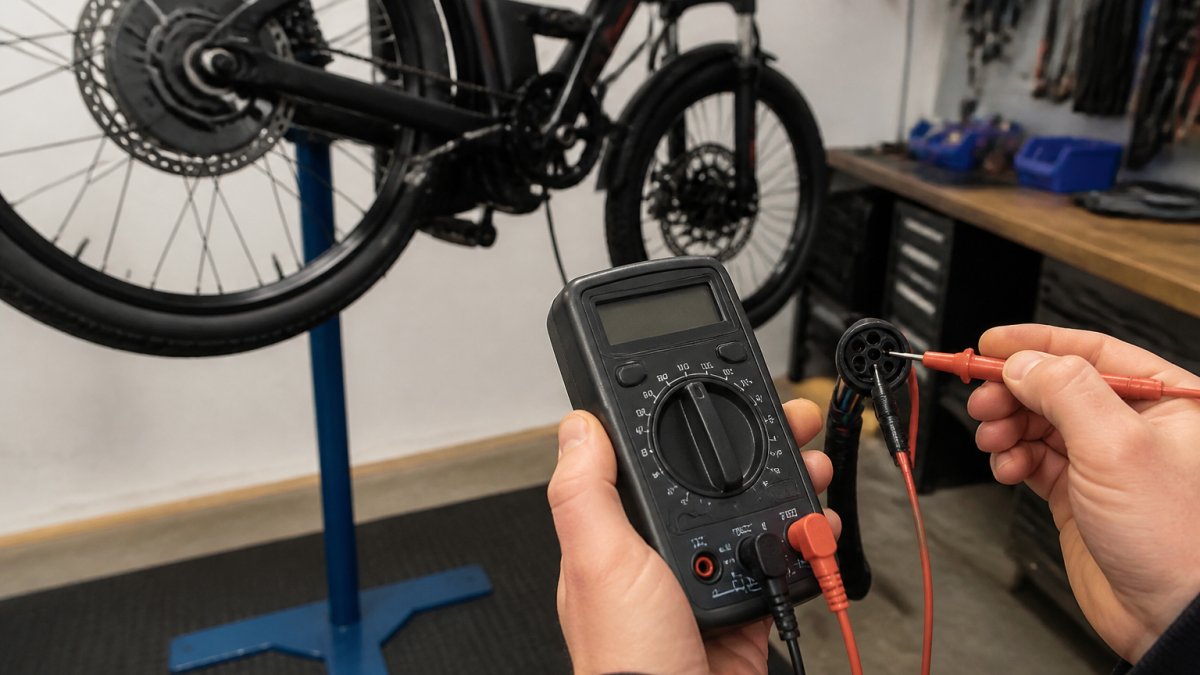
Step 1: Isolate the battery [Time: 5 minutes] Switch off and disconnect the battery before touching any connector.
Step 2: Check phase wire continuity [Time: 5 minutes] Set the multimeter to continuity and test each of the three thick phase wires end to end. A reading that fails to beep means a broken wire.
Step 3: Test the hall sensor connector [Time: 5 minutes] With the controller powered and the wheel off the ground, check the thin sensor wires. Voltage should switch as you turn the wheel slowly.
Step 4: Measure resistance across phases [Time: 5 minutes] Set the meter to resistance and compare the three phase-to-phase readings. They should be close to equal. A reading that is wildly different points to a shorted winding.
Expected Result: You will know whether the fault sits in the wiring, the sensors or the motor itself.
Visit our eBike Servicing & Repairs page →
e-Bike Hub Motor Hall Sensor Test: Checking the Three Wires
A hub motor uses three hall sensors to tell the controller the rotor's position. When one fails, the motor stutters or refuses to start. The e-bike hub motor Hall sensor test is a simple voltage check on the sensor connector.
With the controller powered and the wheel turned slowly by hand, each of the three signal wires should alternate between a low and a high voltage as the magnets pass the sensors. If one wire stays fixed while the other two switch, that sensor has failed.
A failed hall sensor is cheap to replace and does not condemn the motor. What most guides miss is that the connector, not the sensor itself, causes the fault more often than not. Check the plug and pins before ordering a replacement sensor.
What to Ignore: Common Bad Advice About eBike Motor Diagnostics
Plenty of forum advice will cost you money. Here is what to disregard.
- "If the motor cuts out, replace it." Wrong. Test the sensors and wiring first.
- "Any error code means a new controller." Error codes narrow the fault; they rarely confirm a dead part.
- "You can test a motor without disconnecting the battery." Never. Always isolate first.
- "Waterproof motors cannot fail from water." Seals degrade, and water ingress is a real cause of bearing failure.
The real difference between a good and a poor diagnosis comes down to patience. Test one circuit at a time rather than swapping parts and hoping.
When to Hand Your eBike to a Specialist Workshop
Some faults need dealer software or the experience to interpret what the readings mean. Hand the bike over when:
- The motor is a sealed, brand-specific unit with no user-serviceable parts
- You have tested the wiring and sensors and found nothing wrong
- There is physical damage, grinding or play in the hub bearings
- The bike is still under warranty, since DIY work can void it
For riders in Andover and the surrounding area, our fully equipped workshop at County eBikes services all makes and models, so you get a proper diagnosis rather than a parts-swap guess. If you are searching for eBike motor diagnostics near me, booking an appointment with a workshop that carries the right software is the fastest route to an answer.
GOV.UK guidance on electric bike regulations and safety
Conclusion
Motor faults are frustrating, but most are diagnosable with a multimeter and a methodical approach before you spend anything on parts. Start with the symptoms, isolate the circuit, and only replace what has actually failed.
When a fault needs dealer software or you would rather not risk it, County eBikes is here to help. Our Andover workshop offers professional servicing and repairs for all makes and models, expert advice on choosing the right eBike, and free local test rides by appointment. Get started with County eBikes and keep your motor running the way it should.
Frequently Asked Questions
What tools do you need to diagnose an e-bike motor?
A basic diagnostic kit includes a digital multimeter for checking voltage and continuity, a spoke or crank sensor tool if your system uses one, and a laptop or smartphone running the manufacturer's diagnostic software. For hub motors, a Hall sensor tester or the multimeter method will confirm whether the sensors are switching correctly. Most home mechanics can carry out voltage and continuity checks, but reading controller fault codes usually needs brand-specific software that only dealers can access.
Can you test an e-bike motor with a multimeter?
Yes. e-bike motor testing with a multimeter covers three main checks: measuring the voltage arriving at the motor connector, testing continuity across each motor phase wire, and checking the Hall sensor signal wires for a switching voltage as the wheel turns. A multimeter will not tell you the exact fault code stored in the controller, but it will confirm whether power is reaching the motor and whether the phase or sensor circuits are broken.
How do you check an e-bike hub motor's Hall sensors?
An e-bike hub motor Hall sensor test involves locating the five or six thin wires running from the motor to the controller, identifying the sensor signal wires (usually yellow, green and blue), and measuring each one against the black ground wire while slowly rotating the wheel by hand. A working sensor switches between roughly 0V and 5V. If a signal wire stays stuck at 0V or 5V, that Hall sensor has failed.
What are the signs of a faulty e-bike motor?
Common e-bike motor fault symptoms include jerking or stuttering under power, a grinding or clicking noise from the hub, the motor cutting out intermittently, reduced assistance on hills, and error codes on the display. A motor that runs but feels weak often points to a Hall sensor problem, while a completely dead motor usually means a broken phase wire, a failed controller or a battery issue rather than the motor itself.
Can an e-bike diagnostic tool identify a motor fault?
Brand-specific e-bike diagnostic tools read fault codes stored in the controller and can pinpoint issues such as a Hall sensor error, an overcurrent event or a communication fault. Generic multimeter testing confirms whether power and signals are reaching the motor but cannot read stored codes. Combining both approaches gives the clearest picture, which is why a workshop with the right software is often faster than home troubleshooting.
Is it safe to test an e-bike motor at home?
Low-voltage checks with a multimeter are safe for most home mechanics, provided the battery is switched off and the motor connector is unplugged before you start. Avoid opening the motor casing itself, as hub motors contain strong magnets and reassembly is fiddly. If you are unsure which wire is which, or the bike is still under warranty, stop and book it into a workshop rather than risk damaging the controller.